Home loans
Home Loan Prepayment: Should You Reduce the EMI or the Tenure?
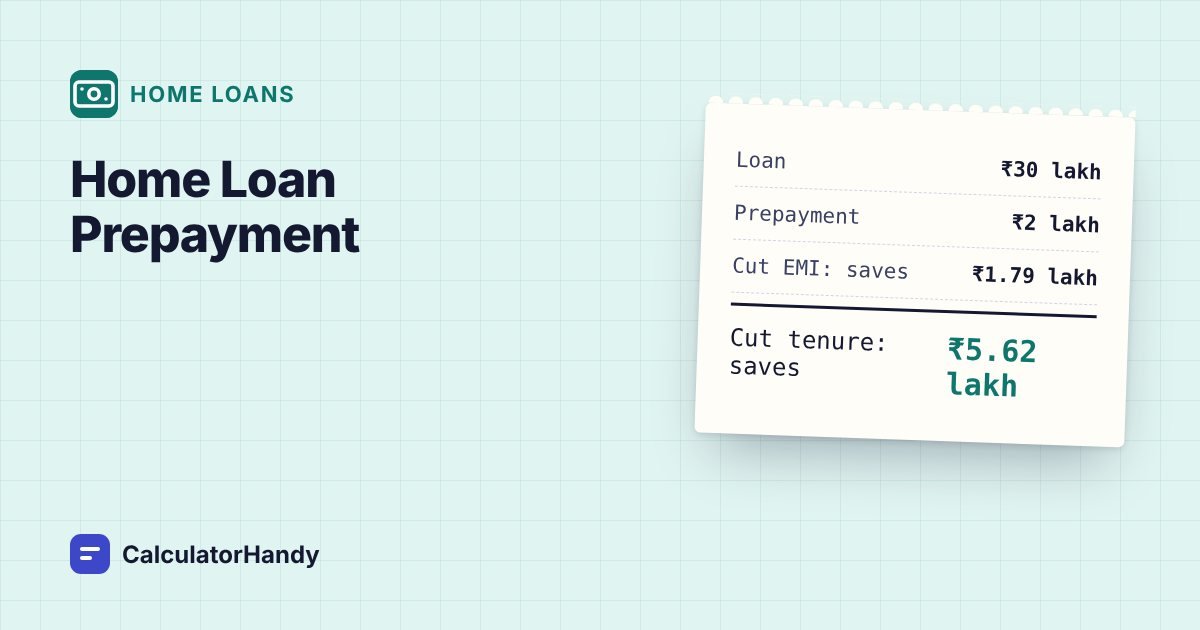
A ₹2 lakh prepayment on a ₹30 lakh home loan saves ₹5.6 lakh if you cut the tenure, but only ₹1.8 lakh if you cut the EMI. Here is why, with the numbers.
You have some extra money: a bonus, an incentive, or savings that have built up. You decide to put ₹2 lakh into your home loan. The bank then asks a question that looks like paperwork but decides how much you save: do you want to reduce your EMI or your tenure?
The example loan
- Loan amount: ₹30,00,000
- Interest rate: 8.5% a year
- Tenure: 20 years (240 months)
- EMI: ₹26,035
Without any prepayment, total interest over 20 years comes to about ₹32.48 lakh, more than the loan itself. After three years of EMIs, about ₹28.05 lakh is still outstanding.
Option 1: keep the EMI, cut the tenure
You pay ₹2 lakh after year three and keep paying ₹26,035 a month. Since the balance is lower, more of each EMI now goes to principal, and the loan closes early.
- Loan ends after 211 months instead of 240, about 29 months sooner
- Total interest drops to roughly ₹26.86 lakh
- Saving: about ₹5.62 lakh
Option 2: keep the tenure, cut the EMI
Same ₹2 lakh, but you ask the bank to spread the lower balance over the remaining 17 years.
- New EMI: about ₹24,178, roughly ₹1,857 a month less
- Loan still ends in month 240
- Total interest drops to roughly ₹30.70 lakh
- Saving: about ₹1.79 lakh
Why the difference is so large
Interest is charged every month on whatever you still owe. When you cut the tenure, the balance keeps falling at the old, faster pace, so it reaches zero years earlier and those final years of interest never happen. When you cut the EMI, you slow the repayment down again, and the loan carries a balance for the full 20 years.
| Reduce tenure | Reduce EMI | |
|---|---|---|
| Monthly EMI | ₹26,035 | ₹24,178 |
| Loan ends | Month 211 | Month 240 |
| Interest saved | ≈ ₹5.62 lakh | ≈ ₹1.79 lakh |
When reducing the EMI still makes sense
- Your income has dropped, or you expect a big expense, and the monthly breathing room matters more than the long-term saving.
- You plan to invest the ₹1,857 a month you free up, and you are disciplined enough to actually do it.
- You are close to retirement and want lower fixed outgoings.
If none of these apply, reducing the tenure is usually the better deal.
Before you prepay
- Keep an emergency fund of a few months of expenses first. Money put into a loan is hard to get back.
- Prepay early in the loan where you can; that is when the balance, and the interest on it, is highest.
- Ask for a fresh repayment schedule after each part-payment and check that it matches what you chose.
To try your own loan, use the Loan Calculator with its yearly schedule, or compare tenures quickly with the EMI Calculator.
Frequently asked questions
Is there a penalty for prepaying a home loan?
For floating-rate home loans taken by individuals for non-business purposes, RBI rules generally do not allow banks to charge prepayment or foreclosure penalties. Fixed-rate and business loans can differ, so read your loan agreement.
How often can I make a part-payment?
It depends on the lender. Many allow several part-payments a year, sometimes with a minimum amount. Check with your bank before you transfer the money.
Should I prepay or invest the money instead?
Prepaying gives a guaranteed saving equal to your loan rate. Investing may earn more or less. Many people keep an emergency fund first, then split extra money between prepayment and investments.