Money basics
Inflation: What Will ₹1 Lakh Be Worth in 20 Years?
See how inflation erodes money over time: what ₹1 lakh of today’s spending will cost in 20 years, what ₹1 lakh will buy then, and how to plan goals for it.
Inflation is easy to ignore because it moves slowly. A 6% rise in prices doesn’t feel like much in any single year. Over 20 years, though, it changes what money means so much that planning without it gives you numbers that are simply wrong.
Two questions, two answers
There are two ways to look at inflation, and both matter:
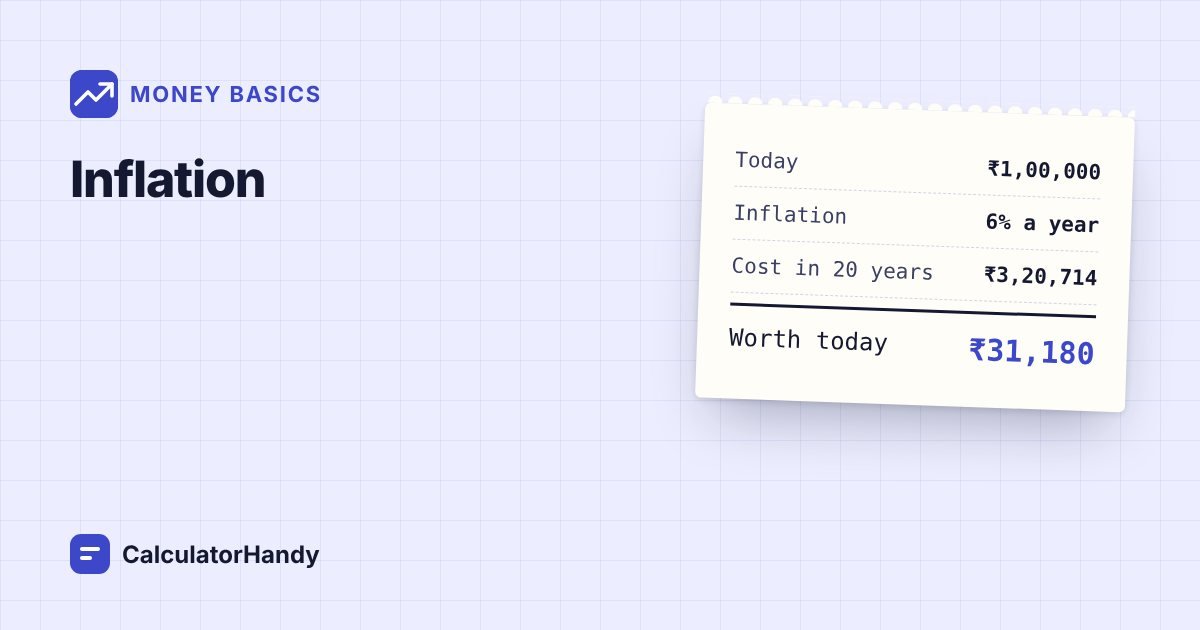
- What will today’s expense cost in the future? Something that costs ₹1,00,000 today, at 6% a year for 20 years, will cost ₹3,20,714.
- What will a future sum be worth in today’s money? ₹1,00,000 received 20 years from now buys what about ₹31,180 buys today.
Both come from the same growth factor: 1.0620 ≈ 3.207. Multiply to go forward, divide to come back.
The formula
Future cost = today’s cost × (1 + inflation)years
Value today = future amount ÷ (1 + inflation)years
A handy rule of thumb: divide 72 by the inflation rate to see how many years it takes for prices to double. At 6%, about 12 years; at 4%, about 18 years.
Why this changes how you set goals
Suppose a college course costs ₹10 lakh today and your child will start in 15 years. At 6% inflation the fee would be about ₹24 lakh; education costs have often risen faster than general prices, so it could be more. Saving for ₹10 lakh would leave a large gap.
Retirement is the same story stretched over longer periods. Monthly expenses of ₹40,000 today become about ₹1.28 lakh a month in 20 years at 6%.
Real returns: the number that actually matters
If your savings earn 7% and inflation is 6%, your buying power grows by only about 1% a year. A savings account paying 3% during 6% inflation is quietly losing value every year, even though the balance goes up.
This is why long-term goals usually need investments that have historically beaten inflation over long periods, with the risks that come with them. A SIP lets you build that up gradually; the SIP Calculator shows the effect of different returns and step-ups.
Making inflation part of every plan
- State every goal in today’s money first, then inflate it to the year you need it.
- Use a higher rate for school fees and medical costs than for everyday spending.
- Review the plan every year or two and update both the inflation rate and your progress.
Investment returns are not guaranteed, and this guide is general information rather than financial advice. For big decisions, talk to a SEBI-registered investment adviser.
Frequently asked questions
What inflation rate should I assume for India?
Retail inflation has varied a lot over the years. Planners often use 5–6% for general expenses, and higher for education and healthcare, which have tended to rise faster. Try more than one rate.
What is a real return?
Roughly, your investment return minus inflation. More precisely, (1 + return) ÷ (1 + inflation) − 1. A 7% return with 6% inflation is a real return of about 0.94%.
Does inflation affect loans?
Yes, in the borrower’s favour. A fixed EMI feels smaller over time as incomes and prices rise, which is one reason long loans become easier to pay in later years.