Online selling
ROAS vs ROI: Which Number Tells You if Your Ads Make Money?
ROAS and ROI measure different things. See both formulas, a worked ad campaign example, the break-even ROAS for your margin and which number to use when.
Ad dashboards love ROAS. Accountants love ROI. Both sound like “return”, and people often use them interchangeably, which is how a campaign can look brilliant on screen and still cost you money. The difference is one word: revenue versus profit.
The two formulas
- ROAS (return on ad spend) = revenue from ads ÷ ad spend
- ROI (return on investment) = (profit − cost) ÷ cost × 100
ROAS tells you how much sales each rupee of advertising produced. ROI tells you how much profit you made relative to what you put in.
A worked campaign
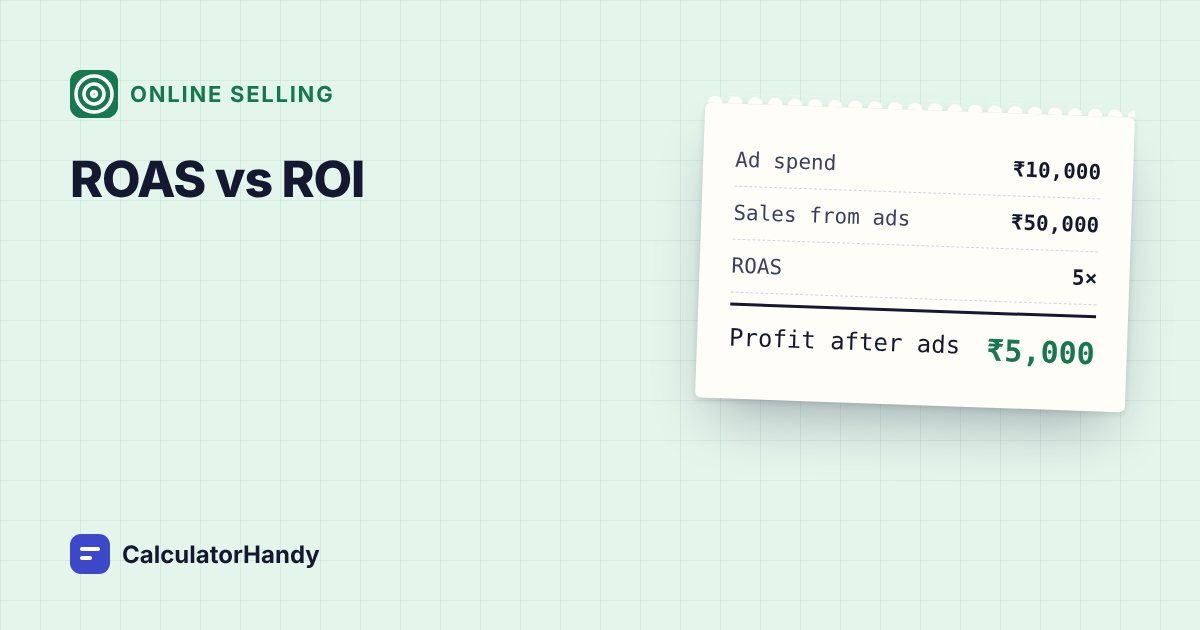
You spend ₹10,000 on ads and they bring in ₹50,000 of sales. Your gross margin (after product cost, shipping and payment fees) is 30%.
- ROAS = 50,000 ÷ 10,000 = 5×
- Gross profit from those sales = 50,000 × 30% = ₹15,000
- Profit after paying for ads = 15,000 − 10,000 = ₹5,000
- Return on the ad spend = 5,000 ÷ 10,000 = 50%
Your break-even ROAS
The most useful number to know before you run any ad:
Break-even ROAS = 1 ÷ gross margin
With a 30% margin, break-even ROAS is 1 ÷ 0.3 = 3.33×. Below that, every sale from an ad loses money; above it, the ads pay for themselves and more.
| Gross margin | Break-even ROAS |
|---|---|
| 20% | 5× |
| 30% | 3.33× |
| 40% | 2.5× |
| 50% | 2× |
| 60% | 1.67× |
This is why low-margin products struggle with paid ads: they need very high ROAS just to stand still.
When to use ROI instead
ROI is the right measure for anything with costs beyond the ad itself: a new product line, a stall at an exhibition, a photo shoot, new packaging. If you spend ₹10,000 on something and it brings back ₹12,500 in total value, ROI is (12,500 − 10,000) ÷ 10,000 = 25%. The ROI Calculator also annualises it when you know how long it took.
Three mistakes to avoid
- Trusting platform attribution blindly. Ad platforms tend to credit themselves generously. Compare with your own order data.
- Ignoring repeat customers. A first order at break-even can be worth it if customers come back. Look at lifetime value with the Customer Acquisition Cost Calculator.
- Forgetting returns. Refunded orders still cost you the ad that brought them in.
Frequently asked questions
What is a good ROAS?
Any ROAS above your break-even ROAS is profitable. That figure is 1 ÷ your gross margin, so it is different for every business.
Can ROI be negative while ROAS looks good?
Yes. A ROAS of 3× can still lose money if your margin is 25%, because the break-even ROAS would be 4×.
Should I include the cost of my time?
For a true ROI, include every cost the campaign created: design, agency or freelancer fees, discounts and tools, not just the ad platform bill.